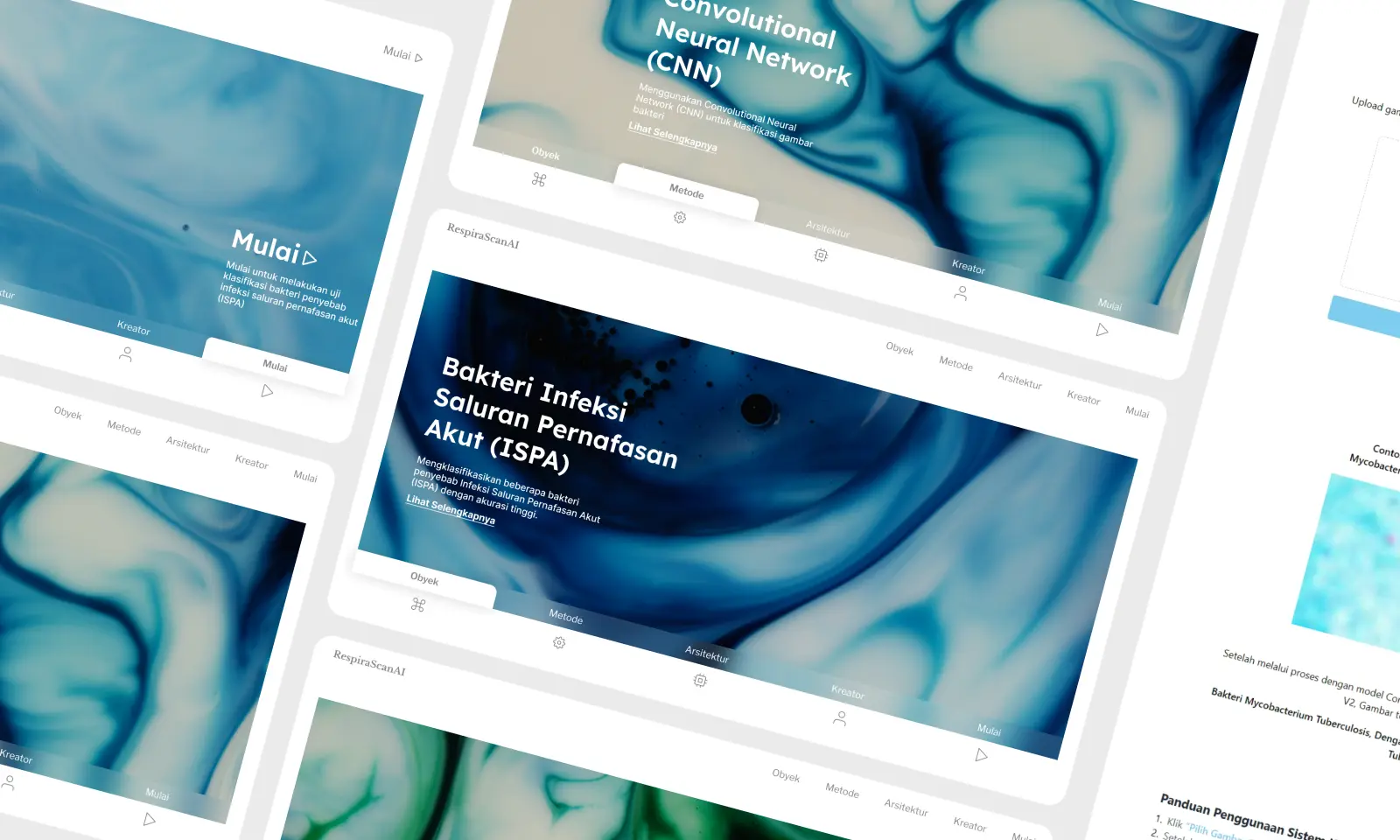
RespiraScan AI
RespiraScan AI is an intelligent web application developed as my undergraduate thesis to classify respiratory bacteria causing Acute Respiratory Infections (ARI/ISPA) from microscopic images. The system leverages a Convolutional Neural Network based on InceptionResNetV2 to provide fast and accurate predictions through an intuitive web interface.
- Role
- AI Engineer & Full Stack Developer
- Client
- Bachelor Thesis
- Duration
- 6 months
- Team
- Solo Project
- Year
- 2025
- Category
- Artificial Intelligence
- Status
- completed
Stack
What it moved.
5
Bacteria Classes
Respiratory bacteria supported
CNN
Architecture
InceptionResNetV2
Web
Platform
Flask-based application
AI
Inference
Real-time prediction
The problem.
Manual identification of respiratory bacteria from microscopic images requires experienced microbiologists and can be time-consuming.
Healthcare facilities with limited laboratory experts often face delays in bacterial identification, slowing diagnosis and treatment.
An automated image classification system can assist healthcare professionals by providing faster preliminary identification.
What I built.
Developed a CNN classification model using the InceptionResNetV2 architecture with transfer learning.
Built a Flask-based web application allowing users to upload microscopic images and instantly receive classification results.
Integrated prediction confidence scores and educational information for each detected bacterial class to improve interpretability.
How it fits together.
A lightweight AI inference system consisting of a Flask backend, TensorFlow inference engine, and responsive web interface.
Frontend
Responsive user interface for uploading microscopic images and displaying AI predictions.
Backend
Flask application responsible for image preprocessing, model inference, and API communication.
AI Model
Deep learning model based on InceptionResNetV2 trained to classify respiratory bacteria.
Image Processing
Image normalization and preprocessing before inference.
What it does.
Microscopic Image Classification
Upload a bacterial microscope image and receive an instant prediction powered by deep learning.
Confidence Score
Displays prediction probabilities to help users understand model confidence.
Educational Information
Provides a short explanation of the predicted bacterial species and related respiratory disease.
Responsive Web Interface
Accessible from desktop and mobile devices with an intuitive user experience.
Fast AI Inference
Optimized prediction pipeline delivers results within seconds.
Seen from the inside.
Drag or scroll horizontally — 4 frames
Where it got hard.
Limited Dataset
What broke
Medical image datasets were relatively small, increasing the risk of overfitting.
How it was fixed
Applied transfer learning with InceptionResNetV2 and data augmentation to improve generalization.
Image Variability
What broke
Microscopic images varied in illumination, magnification, and quality.
How it was fixed
Implemented consistent preprocessing and normalization before model inference.
Model Deployment
What broke
TensorFlow models can be resource-intensive for deployment.
How it was fixed
Integrated an optimized inference pipeline within Flask to provide responsive prediction performance.
What I owned.
Designed and trained the deep learning model.
Collected, prepared, and preprocessed the image dataset.
Developed the Flask backend and AI inference pipeline.
Designed and implemented the responsive frontend interface.
Evaluated model performance and documented research findings.
How it ran.
Research
Month 1
Studied respiratory bacteria classification and collected image datasets.
Model Development
Months 2–3
Built and trained the InceptionResNetV2 model using TensorFlow.
Web Development
Months 4–5
Developed the Flask application and integrated AI inference.
Testing & Thesis
Month 6
Performed evaluation, testing, and completed thesis documentation.
What I took from it.
Transfer learning significantly improves performance when training with limited medical datasets.
Good preprocessing is equally as important as model architecture.
User-friendly interfaces make AI applications more accessible to non-technical users.
Deploying AI models requires balancing prediction accuracy and inference speed.
What I'd do next.
Support additional respiratory bacteria classes.
Deploy using Docker and cloud infrastructure.
Add Grad-CAM visualization for explainable AI.
Provide REST API for integration with laboratory information systems.
Next case study
DynQRIS
Generate Dynamic QRIS from Static QRIS entirely offline in Flutter.